Polynesian
Koa stood before the mirror, his reflection a paradox. He had his father’s strong jaw and the deep, warm eyes of his Samoan mother, but he felt like a stranger in his own skin. Growing up in Sydney, he was surrounded by the superficial markers of Polynesian culture — the “tribal” tattoos he saw on surfers at Bondi Beach were aggressive, jagged shapes that seemed to shout, but said nothing. They lacked mana.
His grandfather, a man whose forearms were a dense tapestry of stories written in ink, had once told him, “Our tattoos are not just on our skin; they are in our skin. They are the lines that connect us to those who came before.” Koa, a university student studying architecture, understood the importance of foundations, of blueprints. He felt his own foundation was missing. He was a man of Polynesian blood with unmarked skin, a house with no story carved into its walls.
His trip to Bangkok was a graduation present to himself, but it was also a pilgrimage. In this bustling international city, a melting pot of cultures, he was determined to find an artist who understood the true meaning of tatau. He wasn’t looking for a fashion statement. He was looking for a language. He sought an artist who knew that the patterns — the spearheads, the ocean currents, the shark teeth — were not just designs, but a vocabulary of strength, protection, and identity.
His search was deliberate. He bypassed the flashy tourist parlors and sought out studios known for their respect for cultural traditions. He poured over portfolios, looking not for the most aggressive designs, but for the most balanced and meaningful. He found PUREink. He was impressed by their 300+ 5-star Google ratings, where clients spoke of the artists’ deep respect for artistry and professionalism. Their portfolio showcased a powerful understanding of culturally significant motifs. The lines were clean, the patterns were authentic, and the overall designs flowed with the natural contours of the body. He saw tattoos that spoke of family, of journeys, of protection. He saw a language he wanted to learn.
The Consultation: Reading the Blueprint of the Soul
In the quiet, clean space of the PUREink studio, Koa felt a sense of reverence. He didn’t come with a picture from the internet. He came with his story. He spoke of his parents, his grandparents, his feeling of being disconnected from his roots, and his desire to build a bridge back to his heritage.
The artist, Bang, a man known for his mastery of large-scale, complex pieces and his architectural approach, listened intently. He didn’t sketch on paper. Instead, he treated the consultation like a project planning session, a core part of his philosophy that “every large piece requires fresh planning.”
“We are building something significant,” Bang explained, his voice that of a master architect. “It must be planned correctly. The body is the foundation, and the design is the structure. We have to ensure the flow is right and fits your body perfectly.” He spoke of how the body is seen as a link between Rangi (Heaven) and Papa (Earth), and how tattoos map that connection. “The upper body is for the spiritual, the lower for the earthly. What is the story we are building today?”
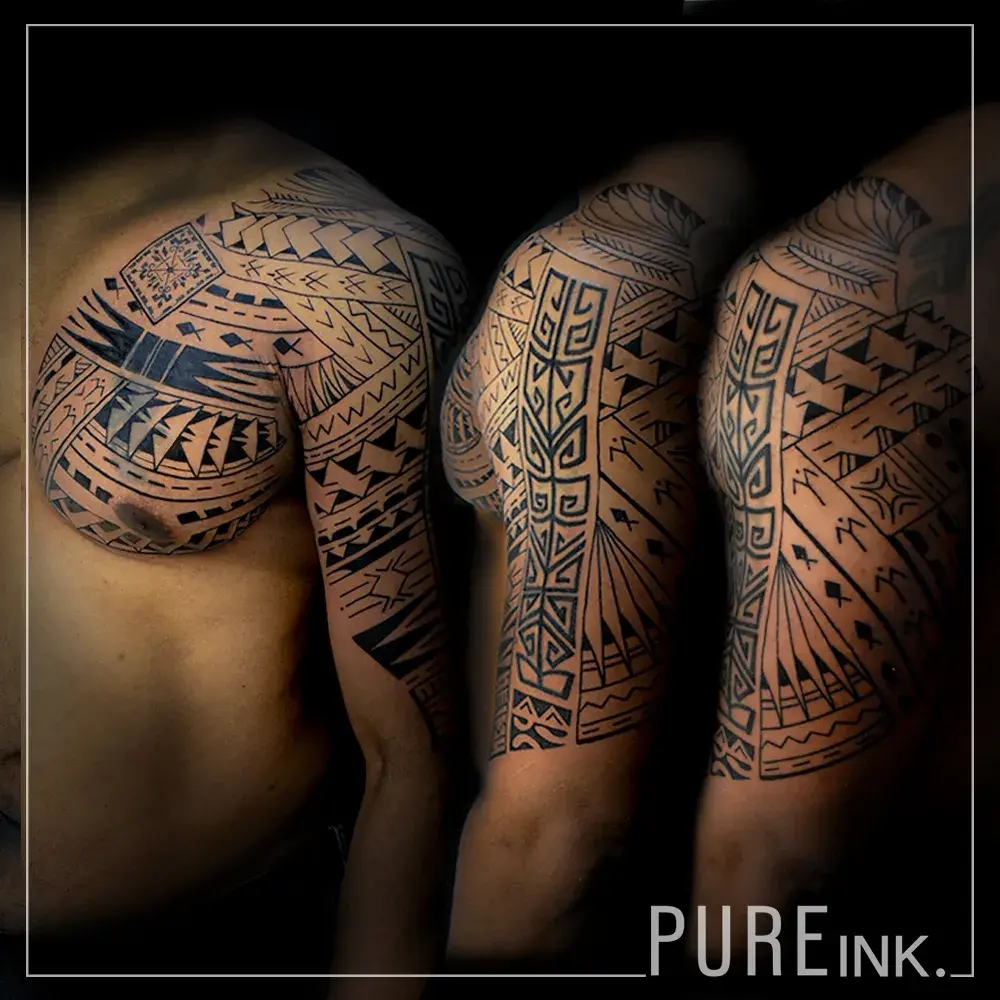
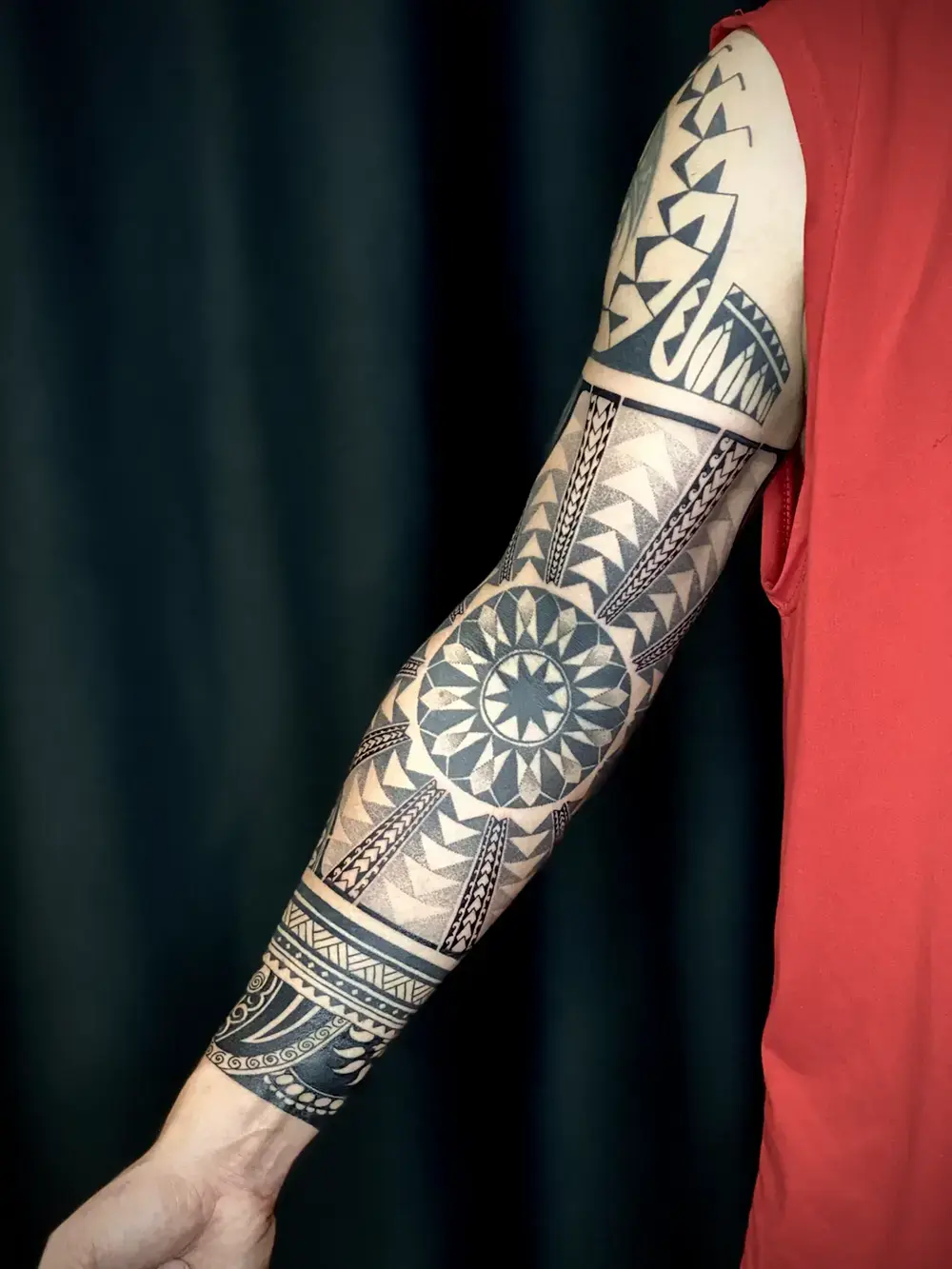
Together, they began to build Koa’s visual genealogy. For his father’s side, they chose Marquesan crosses, symbolizing balance. For his mother’s Samoan heritage, they chose repeating shark teeth — niho mano — a symbol of protection. To represent his own journey and his love for the ocean, they selected a flowing pattern of ocean currents.
Bang mapped it out on his tablet, showing Koa how the elements would integrate, how many sessions it would take, and how the final piece would be a seamless, powerful narrative. “We are creating a protective cloak, a second skin of your identity,” he said. “It will be a permanent reminder of who you are and where you come from. It will give you mana.” Koa felt a profound sense of understanding. This wasn’t just about getting a tattoo; it was about commissioning a masterpiece.
The Process: The Rhythm of the Ancestors
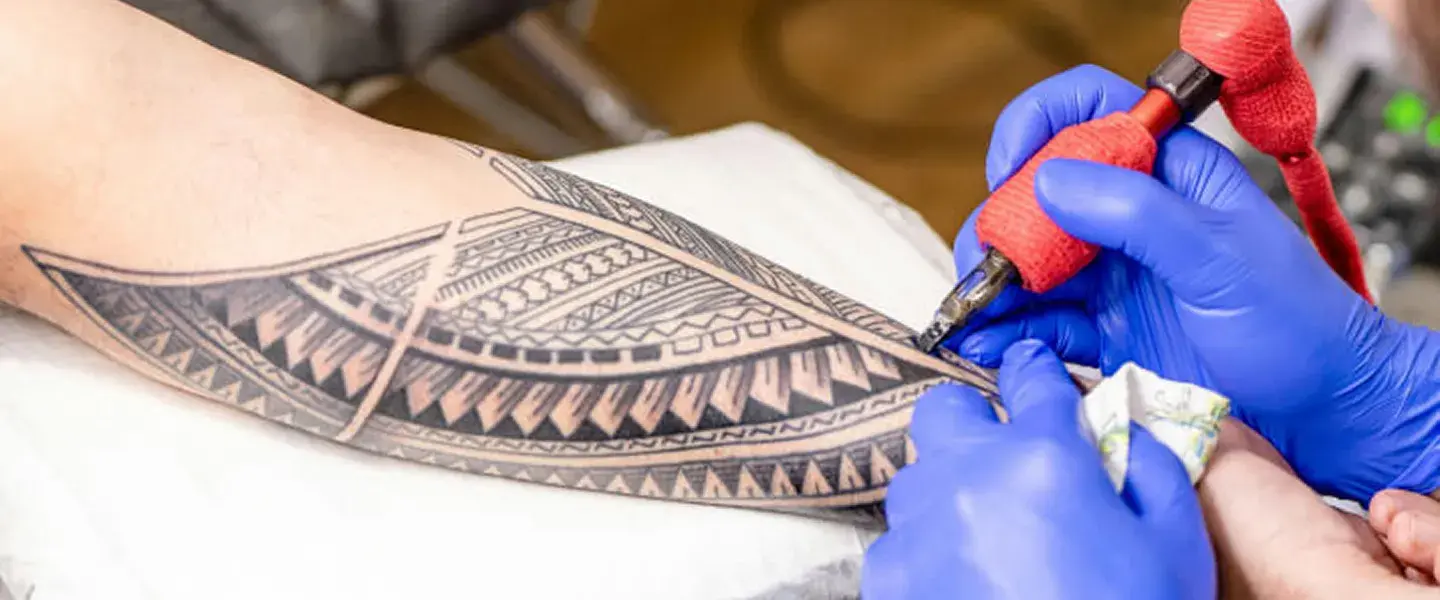
The day of the tattoo felt ceremonial. As the modern tattoo machine buzzed to life — a respectful nod to contemporary safety and precision — Koa focused on his breathing. Bang began to work, his movements confident and rhythmic.
With each line, Koa felt a connection being forged. The sharp sting of the needle was a conduit, a physical sensation that grounded him in the ancient tradition. This pain was different from a simple injury; it was a purposeful, transformative pain. It was the same pain his ancestors had endured, a rite of passage that connected him to them across generations. He thought of his grandfather and felt a surge of strength.
Bang worked with intense focus, meticulously building the patterns. The Marquesan crosses took shape on his shoulder, a symbol of balance at the spiritual top of his body. The protective band of shark teeth wrapped around his bicep, a shield of his Samoan heritage. The ocean currents flowed between them, linking everything together in a design that was both powerful and elegant.
When the session was over, Koa looked in the mirror. The man looking back at him was no longer a stranger. The lines on his skin were a map of his identity, a declaration of his heritage. The empty walls of his house were now covered in the stories of his ancestors. The tattoo was not just on his skin; it was in his soul. He finally felt complete.
The Language of the Islands: Your Questions Answered
A Polynesian tattoo is a powerful statement. Understanding its cultural significance is the first step in earning the right to wear it.
Is it okay for a non-Polynesian person to get a Polynesian tattoo?
This is a complex and sensitive issue. While the beauty of Polynesian art is undeniable, it is a living cultural practice steeped in deep meaning. Getting these tattoos without understanding their significance can be seen as cultural appropriation. If you are not of Polynesian descent, it is crucial to approach the process with the utmost respect. This means seeking out an artist who is a cultural practitioner or has deep knowledge of the tradition, focusing on the meaning and story, and wearing the tattoo with a sense of humility and respect for its origins.
Our artists are dedicated to this respectful approach and will guide you in creating a piece that honors the culture, rather than simply copying it.
What’s the difference between all the Polynesian styles?
Polynesia is a vast region, and different island groups developed their own unique artistic styles. For example:
- Samoan (Tatau): Known for dense, geometric patterns, often covering large areas of the body (like the pe’a for men and malu for women).
- Marquesan (Patutiki): Characterized by bold, graphic symbols like the Marquesan cross, lizards, and turtles, often covering the entire body in a “second skin.”
- Māori (Tā Moko): Famous for its swirling, spiral patterns (koru) and deep cultural connection to facial tattoos that tell a detailed family history.
- Hawaiian (Kakau): Asymmetrical geometric patterns traditionally used to tell stories of lineage and protect the body.
Do the symbols have fixed meanings?
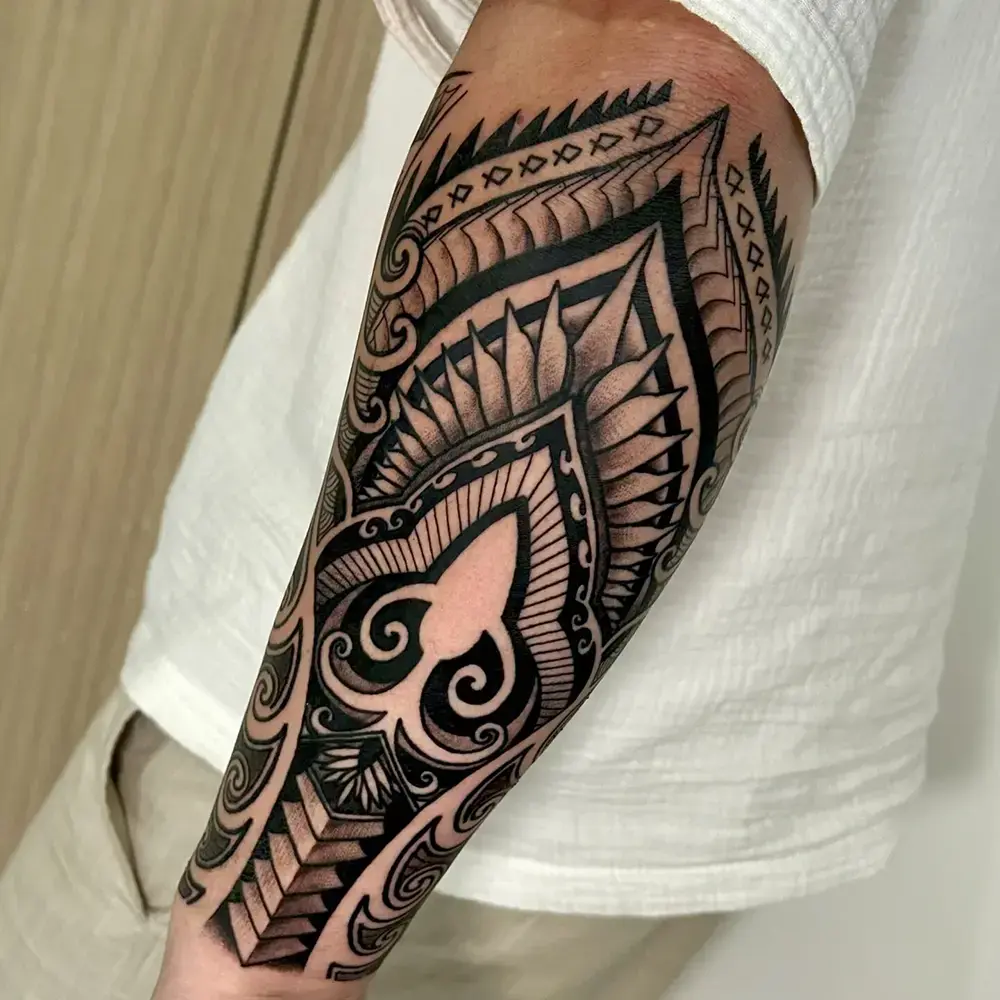
Yes and no. Many symbols have well-established traditional meanings (e.g., shark teeth for protection, turtles for longevity and family, the ocean for life and journeys). However, the true meaning of a Polynesian tattoo comes from how these symbols are combined to tell a specific, personal story. The placement on the body also significantly influences the meaning.
A skilled artist doesn’t just copy symbols; they weave them together into a unique narrative for the wearer.
Are traditional hand-tapping tools still used?
Yes, some cultural practitioners still use the traditional hand-tapping method (au). This is a deeply sacred, ritualistic, and painful process. However, most modern studios, including PUREink, use modern tattoo machines. This ensures a higher level of safety, hygiene, and precision while still honoring the traditional designs and their meanings.
How do I design a meaningful Polynesian tattoo?
The key is to focus on your story, not just on aesthetics. Think about what you want the tattoo to represent:
- Your family?
- A significant life journey?
- Your values and beliefs?
- Your connection to the ocean or nature?
Bring these ideas to your artist, and together you can choose the right symbols and placement to create a tattoo that is a true and respectful representation of your personal narrative.
Find Your Lines
A Polynesian tattoo is more than art; it is a commitment to a story, a culture, and an identity. It is a declaration of who you are, written in the ancient language of the islands. The artists at PUREink are dedicated to honoring this tradition, working with you to create a tattoo that is not only beautiful but also culturally respectful and deeply meaningful.
“This was the best experience. As the companion of an American tattoo artist and former shop owner myself, I was pleasantly surprised by the level of skill and professionalism. The staff were kind and very accommodating.” – Morgan M., Google Review
A Polynesian tattoo is a commitment to a story and a culture. We are dedicated to honoring this tradition.
Let’s bring your idea to life
Alternatively, Book Your Consultation